


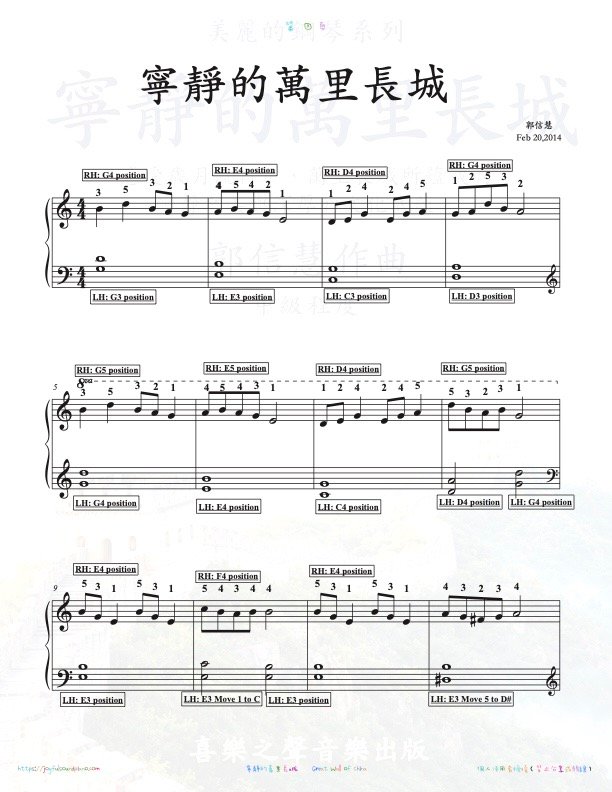
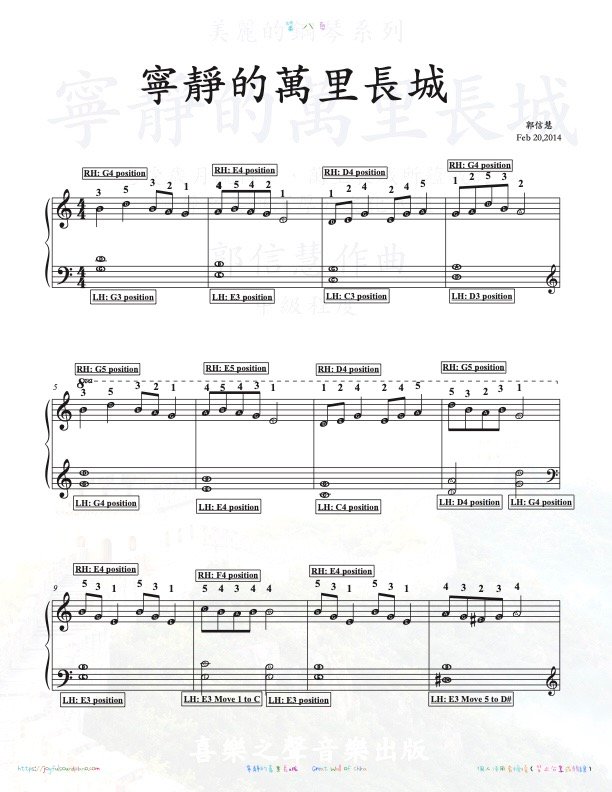
Great Wall of China
Piano Solo Sheet Music for Intermediate Level
Great Wall of China. Intermediate Level
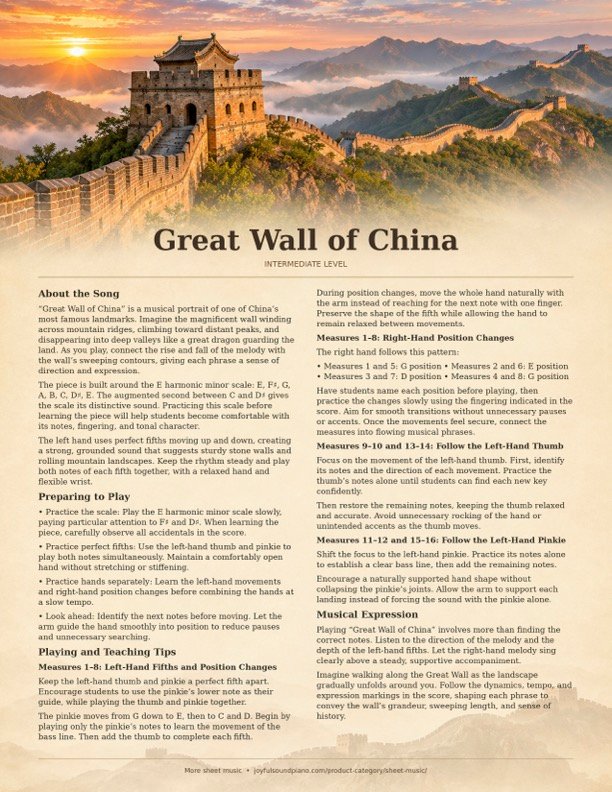
About the Song
“Great Wall of China” is a musical portrait of one of China’s most famous landmarks. Imagine the magnificent wall winding across mountain ridges, climbing toward distant peaks, and disappearing into deep valleys like a great dragon guarding the land. As you play, connect the rise and fall of the melody with the wall’s sweeping contours, giving each phrase a sense of direction and expression.
The piece is built around the E harmonic minor scale: E, F♯, G, A, B, C, D♯, E. The augmented second between C and D♯ gives the scale its distinctive sound. Practicing this scale before learning the piece will help students become comfortable with its notes, fingering, and tonal character.
The left hand uses perfect fifths moving up and down, creating a strong, grounded sound that suggests sturdy stone walls and rolling mountain landscapes. Keep the rhythm steady and play both notes of each fifth together, with a relaxed hand and flexible wrist.
Preparing to Play
- Practice the scale: Play the E harmonic minor scale slowly, paying particular attention to F♯ and D♯. When learning the piece, carefully observe all accidentals in the score.
- Practice perfect fifths: Use the left-hand thumb and pinkie to play both notes simultaneously. Maintain a comfortably open hand without stretching or stiffening.
- Practice hands separately: Learn the left-hand movements and right-hand position changes before combining the hands at a slow tempo.
- Look ahead: Identify the next notes before moving. Let the arm guide the hand smoothly into position to reduce pauses and unnecessary searching.
Playing and Teaching Tips
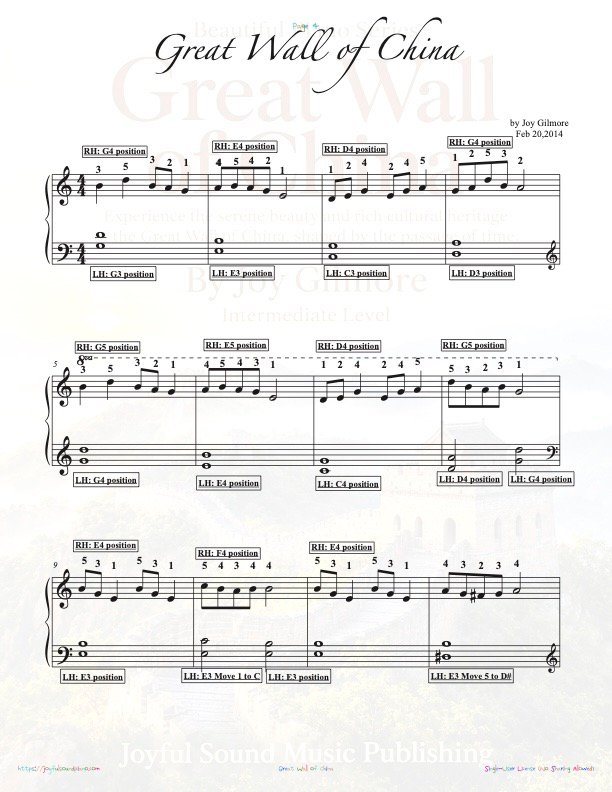
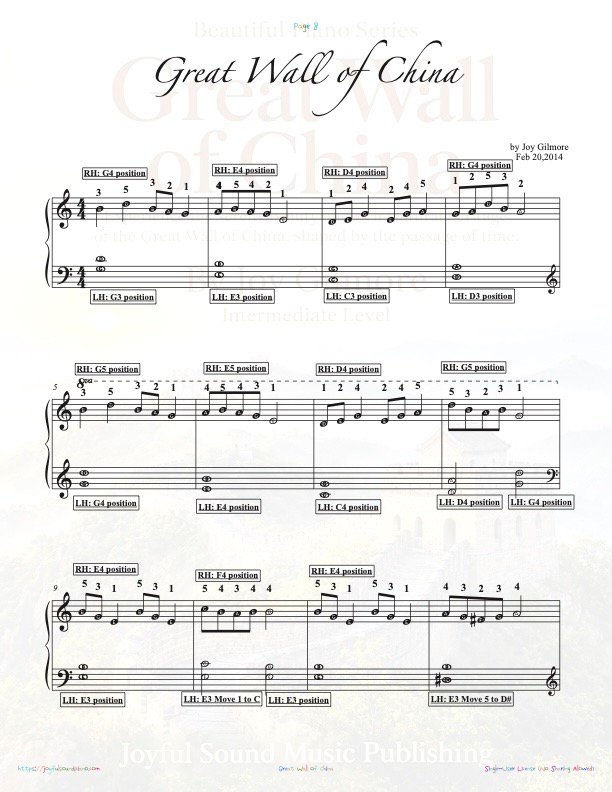
Measures 1–8: Left-Hand Fifths and Position Changes
Keep the left-hand thumb and pinkie a perfect fifth apart. Encourage students to use the pinkie’s lower note as their guide, while playing the thumb and pinkie together.
The pinkie moves from G down to E, then to C and D. Begin by playing only the pinkie’s notes to learn the movement of the bass line. Then add the thumb to complete each fifth.
During position changes, move the whole hand naturally with the arm instead of reaching for the next note with one finger. Preserve the shape of the fifth while allowing the hand to remain relaxed between movements.
Measures 1–8: Right-Hand Position Changes
The right hand follows this pattern:
- Measures 1 and 5: G position
- Measures 2 and 6: E position
- Measures 3 and 7: D position
- Measures 4 and 8: G position
Have students name each position before playing, then practice the changes slowly using the fingering indicated in the score. Aim for smooth transitions without unnecessary pauses or accents. Once the movements feel secure, connect the measures into flowing musical phrases.
Measures 9–10 and 13–14: Follow the Left-Hand Thumb
Focus on the movement of the left-hand thumb. First, identify its notes and the direction of each movement. Practice the thumb’s notes alone until students can find each new key confidently.
Then restore the remaining notes, keeping the thumb relaxed and accurate. Avoid unnecessary rocking of the hand or unintended accents as the thumb moves.
Measures 11–12 and 15–16: Follow the Left-Hand Pinkie
Shift the focus to the left-hand pinkie. Practice its notes alone to establish a clear bass line, then add the remaining notes.
Encourage a naturally supported hand shape without collapsing the pinkie’s joints. Allow the arm to support each landing instead of forcing the sound with the pinkie alone.
Musical Expression
Playing “Great Wall of China” involves more than finding the correct notes. Listen to the direction of the melody and the depth of the left-hand fifths. Let the right-hand melody sing clearly above a steady, supportive accompaniment.
Imagine walking along the Great Wall as the landscape gradually unfolds around you. Follow the dynamics, tempo, and expression markings in the score, shaping each phrase to convey the wall’s grandeur, sweeping length, and sense of history.
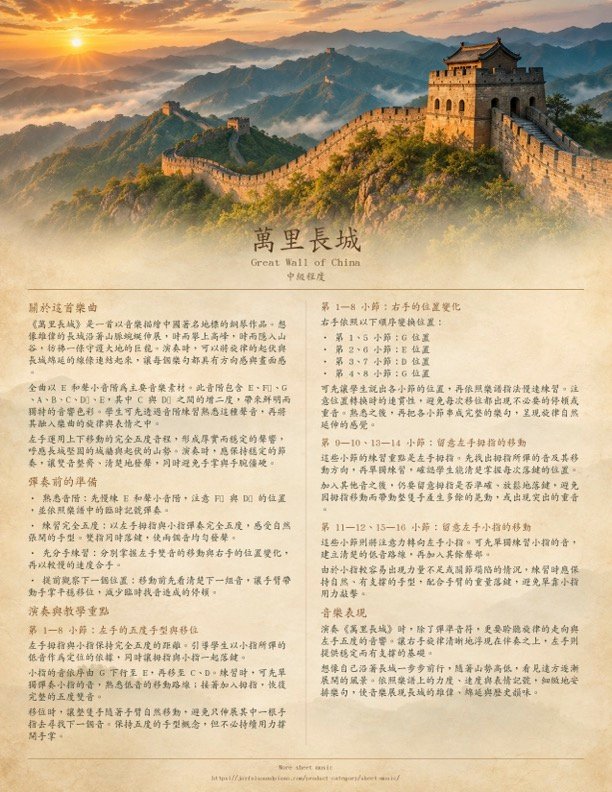
萬里長城. 中級程度
關於這首樂曲
《萬里長城》是一首以音樂描繪中國著名地標的鋼琴作品。想像雄偉的長城沿著山脈蜿蜒伸展,時而攀上高峰,時而隱入山谷,彷彿一條守護大地的巨龍。演奏時,可以將旋律的起伏與長城綿延的線條連結起來,讓每個樂句都具有方向感與畫面感。
全曲以 E 和聲小音階為主要音樂素材。此音階包含 E、F♯、G、A、B、C、D♯、E,其中 C 與 D♯ 之間的增二度,帶來鮮明而獨特的音響色彩。學生可先透過音階練習熟悉這種聲音,再將其融入樂曲的旋律與表情之中。
左手運用上下移動的完全五度音程,形成厚實而穩定的聲響,呼應長城堅固的城牆與起伏的山勢。演奏時,應保持穩定的節奏,讓雙音整齊、清楚地發聲,同時避免手掌與手腕僵硬。
彈奏前的準備
- 熟悉音階: 先慢練 E 和聲小音階,注意 F♯ 與 D♯ 的位置,並依照樂譜中的臨時記號彈奏。
- 練習完全五度: 以左手拇指與小指彈奏完全五度,感受自然張開的手型。雙指同時落鍵,使兩個音均勻發聲。
- 先分手練習: 分別掌握左手雙音的移動與右手的位置變化,再以較慢的速度合手。
- 提前觀察下一個位置: 移動前先看清楚下一組音,讓手臂帶動手掌平穩移位,減少臨時找音造成的停頓。
演奏與教學重點
第 1–8 小節:左手的五度手型與移位
左手拇指與小指保持完全五度的距離。引導學生以小指所彈的低音作為定位的依據,同時讓拇指與小指一起落鍵。
小指的音依序由 G 下行至 E,再移至 C、D。練習時,可先單獨彈奏小指的音,熟悉低音的移動路線;接著加入拇指,恢復完整的五度雙音。
移位時,讓整隻手隨著手臂自然移動,避免只伸展其中一根手指去尋找下一個音。保持五度的手型概念,但不必持續用力撐開手掌。
第 1–8 小節:右手的位置變化
右手依照以下順序變換位置:
- 第 1、5 小節:G 位置
- 第 2、6 小節:E 位置
- 第 3、7 小節:D 位置
- 第 4、8 小節:G 位置
可先讓學生說出各小節的位置,再依照樂譜指法慢速練習。注意位置轉換時的連貫性,避免每次移位都出現不必要的停頓或重音。熟悉之後,再把各小節串成完整的樂句,呈現旋律自然延伸的感覺。
第 9–10、13–14 小節:留意左手拇指的移動
這些小節的練習重點是左手拇指。先找出拇指所彈的音及其移動方向,再單獨練習,確認學生能清楚掌握每次落鍵的位置。
加入其他音之後,仍要留意拇指是否準確、放鬆地落鍵,避免因拇指移動而帶動整隻手產生多餘的晃動,或出現突出的重音。
第 11–12、15–16 小節:留意左手小指的移動
這些小節則將注意力轉向左手小指。可先單獨練習小指的音,建立清楚的低音路線,再加入其餘聲部。
由於小指較容易出現力量不足或關節塌陷的情況,練習時應保持自然、有支撐的手型,配合手臂的重量落鍵,避免單靠小指用力敲擊。
音樂表現
演奏《萬里長城》時,除了彈準音符,更要聆聽旋律的走向與左手五度的音響。讓右手旋律清晰地浮現在伴奏之上,左手則提供穩定而有支撐的基礎。
想像自己沿著長城一步步前行,隨著山勢高低,看見遠方逐漸展開的風景。依照樂譜上的力度、速度與表情記號,細緻地安排樂句,使音樂展現長城的雄偉、綿延與歷史韻味。
樂譜打印:
這個PDF文件設計成雙面打印,看起來像一本樂譜書。因此,某些歌曲中可能會有一頁是空白的,這是出於設計的需要。不過,您也可以選擇只打印樂譜的頁面。




Reviews
There are no reviews yet.